Mattress research and comparison
Vispring Devonshire: A Framework for Evaluating Construction and Comfort
A mattress can be described in measurements, materials, and carefully chosen adjectives; sleeping on it is a more personal matter. The Vispring Devonshire is best understood by separating what its published construction tells us from what only a particular sleeper can determine.
Published October 18, 2026
Mattress descriptions often arrive in a language of certainty. A surface is “supportive,” a filling “breathable,” a spring “responsive.” These terms may point toward real design features, but they do not settle the central question: how will the mattress feel, night after night, to the person lying on it? That distinction matters when evaluating the Vispring Devonshire, a model whose construction is described in unusual detail and whose advertised options invite comparison rather than a single, universal verdict.
The Devonshire is presented as an entry point into Vispring’s hand-crafted range. Its design combines British fleece wool, a wool-and-viscose ticking, and a single tier of pocketed steel springs. The product information also specifies four tension choices—Soft, Medium, Firm, and Extra Firm—and says King sizes can be split down the middle for partners seeking different tensions. These are useful facts. They are not, by themselves, a prediction of comfort.
A rigorous assessment begins with that modest principle: record what is documented, distinguish it from marketing language, and test the remaining questions against the sleeper’s own needs. This guide uses the available Devonshire specifications as a starting point. Because product construction and options can change, readers should verify details with the manufacturer or an authorized seller before relying on them.
Start with the construction, not the adjectives
The Devonshire’s stated materials form a layered system. Its ticking is woven from wool and viscose. Beneath the cover, hand-teased Devonshire fleece wool is described as the immediate comfort layer, with another layer of British fleece wool below it. The support system is a single tier of Vanadium steel coils, each housed in a calico pocket. In King size, the stated spring count is 1,716. The border is secured with two rows of hand side-stitching, while hand-tufting with felt washers anchors the fillings.
Each detail suggests a question a comparison-minded reader can ask. What does the cover contain, and how might it feel against the body? How much wool is used, and how is it arranged? What kind of spring system lies beneath the fillings? What is the spring count for the size being considered? Are edge and filling-stabilization methods described? A specification sheet that answers these questions allows a more meaningful comparison than one that relies on a broad label such as “luxury” or “natural.”
The stated materials should also be read precisely. “Wool and viscose” describes the ticking, not the entire mattress. The product details identify wool layers and a steel spring unit, but readers looking for a complete materials inventory may want to ask about every component, including any adhesives, fire-resistant materials, or other elements not itemized in the description. The absence of a detail from a product page does not establish that a material is or is not present.
The same discipline applies to country-of-origin language. “British fleece wool” is a specific claim about the wool layers, but it does not necessarily mean every material or production stage has the same origin. Readers for whom sourcing, animal welfare, or environmental impact is important should seek documentation that addresses those questions directly, rather than treating one material description as a complete account of the supply chain.
What pocketed springs can—and cannot—tell you
In a pocket-spring system, individual coils sit inside fabric pockets rather than being joined into one open spring network. The Devonshire’s product information says each coil responds independently to weight. That is a description of construction and intended behavior. It can help explain why a manufacturer might present pocketed springs as a way to accommodate differences in load across the sleeping surface. It does not prove how much motion a partner will feel, or whether the mattress will maintain a particular spinal position.
The stated King-size count—1,716 coils—gives readers a concrete figure to record, but spring count is not a stand-alone score. Counts may vary by size, and a higher number does not automatically establish better comfort, durability, or support. Coil design, wire characteristics, pocket construction, arrangement, mattress dimensions, and the layers above the spring unit all matter. When comparing mattresses, check that counts refer to equivalent sizes and comparable components. If one maker reports a whole-mattress count and another reports only a particular spring unit, the numbers are not directly comparable.
The product description identifies the coils as Vanadium steel and says the material is intended to retain tension longer than standard carbon steel. That is a manufacturer claim about material performance. A reader evaluating longevity should look for supporting warranty terms, care instructions, independent testing where available, and a clear definition of what counts as a defect. A material description can explain design intent; it cannot substitute for evidence about the lifespan of a particular mattress in ordinary use.
Edge construction deserves similar attention. Two rows of hand side-stitching are described as securing border coils and maintaining a consistent surface toward the perimeter. This gives a buyer something specific to compare with other edge treatments. It does not tell us exactly how the edge will feel to someone sitting on it, how much usable sleeping area it creates, or how it will perform after years of use. Those are outcomes that require either credible testing or firsthand assessment.
The wool layers: a material story, not a comfort guarantee
Wool appears at several points in the Devonshire’s description, but the layers are not presented as interchangeable. The hand-teased Devonshire fleece wool sits close to the surface and is said to allow air movement through opened fibers. A further layer of British fleece wool is described as adding depth and resilience. The distinction gives the reader a preliminary map of the mattress: cover, surface filling, deeper filling, and spring unit.
Natural fibers can influence how a bed feels, absorbs moisture, and manages warmth, but those effects depend on the complete construction and the sleeper’s environment. Room temperature, bedding, sleepwear, individual heat perception, and the mattress base all contribute to the experience. “Breathable” should therefore be treated as a design description rather than a promise that every warm sleeper will remain cool.
Nor does a wool filling, on its own, establish that a mattress is organic, hypoallergenic, chemical-free, or suitable for people with particular sensitivities. Such claims require their own evidence and definitions. A consumer with wool sensitivity, respiratory concerns, or specific chemical restrictions should ask targeted questions and consult relevant health professionals where appropriate. General material language is not medical advice.
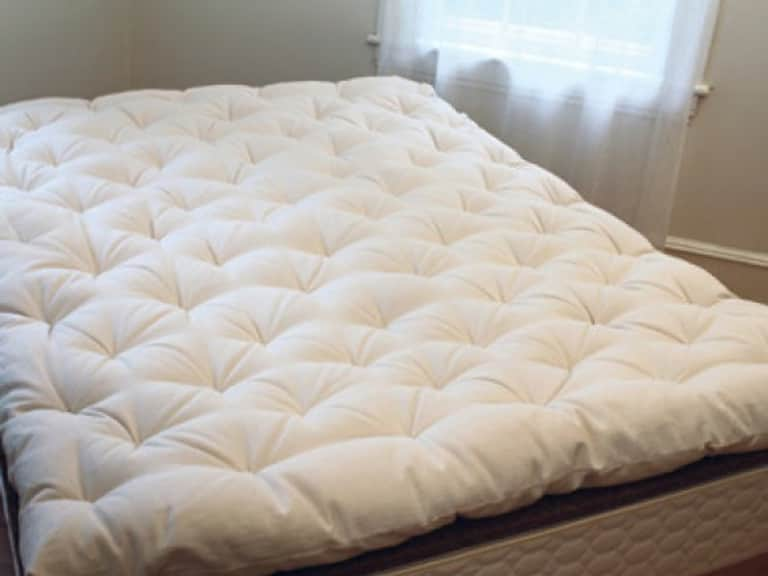
Hand-tufting is another construction detail worth understanding. The product description says felt washers are used to anchor fillings at regular intervals, helping prevent lateral movement. That suggests an approach to stabilizing internal layers. A useful comparison asks whether other models use tufting, quilting, or another method, and whether the manufacturer explains the practical implications. The presence of a hand process may interest a buyer, but “handmade” is not a performance measure by itself.
Firmness and tension: translate labels into questions
Soft, Medium, Firm, and Extra Firm are the four tension options stated for the Devonshire. The range makes the model more adaptable on paper, but firmness labels are not universal units. One company’s Medium may not match another’s. Even within a single model, perceived firmness can vary according to body weight, proportions, sleep position, the base beneath the mattress, and personal preference.
Rather than asking which label is “right,” begin with what the sleeper needs the surface to do. A side sleeper may pay close attention to pressure around the shoulder and hip. Someone who sleeps on their back may focus on whether the lower back feels adequately supported without excessive pressure. A stomach sleeper may be especially attentive to the way the pelvis settles. These are prompts for assessment, not rigid rules: bodies and sleeping habits differ, and a person’s preferred position may change during the night.
When trying a mattress, spend enough time in the positions normally used at home. Notice whether pressure builds, whether movement feels easy, and whether the body seems to settle into a comfortable posture. A brief showroom test cannot reproduce a month of sleep, but it can surface obvious mismatches. If possible, review the trial period, return conditions, delivery costs, and exchange rules before purchase. These policies are part of the practical product experience, even though they do not alter the mattress’s construction.
The split-tension King option is a notable detail for couples whose preferences differ. The description says King sizes can be split across the centre. Before treating this as a complete solution, confirm how the split is configured, whether each side can be ordered at a different tension, and how the join behaves with the chosen frame and bedding. Also establish whether this option is available in the precise size and configuration under consideration. A listed feature deserves verification at the point of purchase.
A practical comparison framework
To compare the Devonshire with another mattress, use the same questions for both. This prevents a polished description from gaining an advantage simply because it contains more evocative language. A short record can make the exercise more useful than a collection of impressions.
- Materials: Record the cover fibers, filling layers, spring materials, and any components the manufacturer identifies. Mark unanswered questions rather than filling gaps with assumptions.
- Support system: Note whether the mattress uses pocketed coils, another spring arrangement, foam, latex, or a combination. Record spring count only alongside mattress size and the manufacturer’s definition of the count.
- Comfort options: Write down the available tension or firmness labels and ask whether they can be tested, exchanged, or configured differently for each partner.
- Dimensions and weight: Confirm exact finished dimensions, depth, and weight for the selected size. These affect bed-frame compatibility, fitted-sheet fit, delivery, and maneuvering.
- Care: Check whether the mattress can be rotated, whether it should not be turned over, what kind of base is recommended, and how spills or stains should be handled.
- Terms: Compare warranty coverage, exclusions, trial or return conditions, and any required maintenance. Separate a warranty’s duration from what it actually covers.
- Evidence and date: Save the product specifications and note when they were checked. Manufacturers may update models, options, or language.
This framework also helps distinguish three kinds of statement. A coil count or listed material is a specification. A statement that a layer is intended to improve resilience is a design rationale. “This is comfortable” is an experience claim, which can only be meaningful when the person, conditions, and basis of judgment are clear. Keeping those categories separate is the simplest form of consumer research.
Care, the bed base, and the life of the mattress
The details available here describe the Devonshire’s materials and construction but do not provide a complete care schedule. That gap is worth closing before purchase. Ask whether the mattress should be rotated, whether it is designed to be used on one side only, what support the bed base must provide, and which cleaning methods are permitted. A natural-fiber construction should not be assumed to require a particular routine without manufacturer guidance.
The base is not an afterthought. A mattress and its support surface work together, and an unsuitable frame may affect feel or may conflict with warranty requirements. Check slat spacing, centre support, frame dimensions, and any other specifications given for the chosen size. If the mattress is unusually heavy or deep, consider the practicalities of moving it through doorways and maintaining access to the room. These are unglamorous questions, but they tend to become urgent on delivery day.
Protective bedding can help manage ordinary wear, but it also changes the surface between sleeper and mattress. A thick pad or topper may alter the way the Devonshire’s wool layers and tension are perceived. If assessing the mattress in a store, ask what coverings are in use. At home, introduce additional layers deliberately, one at a time, so it is easier to tell what is contributing to warmth, pressure relief, or a changed feel.
Expected lifespan is particularly easy to overstate. The description says the materials and construction are intended to maintain resilience, but a precise service life cannot be inferred from those phrases alone. Usage, weight distribution, moisture, maintenance, the foundation, and the individual mattress all play a role. Instead of relying on a broad longevity promise, look for clearly stated warranty terms and ask the seller how to identify normal wear versus a covered fault.
What the Devonshire may suit—and what remains unknown
The available specifications may appeal to people who want a pocket-spring mattress with wool fillings, value a choice of tension, and are interested in a split King configuration. The layered description also gives comparison-minded shoppers more material to work with than a simple label. Someone seeking an all-foam construction, a fully specified organic mattress, or a product with a clearly documented cleaning method will need to verify whether the Devonshire meets those particular requirements; the details presented here do not settle them.
There is no basis for declaring the Devonshire ideal for every sleeping position, body type, or temperature preference. Nor can a construction description establish that it will relieve pain or treat a health condition. Those claims require evidence beyond the product specifications, and medical concerns should be discussed with a qualified clinician. A mattress can be an important part of a sleep environment, but it is not a substitute for diagnosis or treatment.
For readers comparing it with other mattresses, a useful benchmark is not whether the Devonshire sounds more elaborate. It is whether its stated construction, comfort options, care requirements, and purchase terms line up with the criteria that matter to them. A less ornate model may meet those criteria better; a more detailed one may justify closer inspection. The answer is individual, and the research process should make that individuality visible rather than obscure it.
A concise evaluation checklist
Before making a decision, use this checklist to turn a long product description into a manageable set of verifiable questions:
- Is the current model still described as having wool-and-viscose ticking, two wool filling layers, and a single tier of pocketed Vanadium steel springs?
- Does the stated count of 1,716 apply to the King size being considered, and how does the count change in other sizes?
- Which of Soft, Medium, Firm, or Extra Firm can be ordered in the selected size?
- How is a split-tension King configured, and is it available for the chosen delivery region?
- What base is recommended, and what care routine is required?
- What are the precise warranty, trial, exchange, and return terms?
- Are there unanswered questions about sourcing, certifications, sensitivities, or component materials that matter to the household?
- Can the mattress be tested under realistic conditions, or is there another meaningful way to assess comfort before committing?
Answers should be recorded with a date, particularly when specifications are gathered from a retailer rather than directly from the manufacturer. Where sources disagree, ask which description applies to the current model and selected configuration. A careful buyer does not have to become a materials scientist; simply insisting on comparable, current information can remove much of the fog.
The useful conclusion
The Vispring Devonshire can be evaluated as a particular arrangement of wool, pocketed steel springs, edge stitching, and tufting—not as a promise that a single mattress will satisfy every sleeper. Its four tension options and the stated split-King possibility are practical variables to investigate. Its King-size spring count and material claims provide points of comparison, while its care requirements, full component details, and real-world feel remain matters to verify.
That may sound less decisive than a verdict. It is more useful. Mattress comfort is not a universal property waiting to be discovered in a product name; it emerges from the meeting of construction, body, room, habits, and expectation. Begin with the specifications, test the experience where possible, and keep documented facts apart from impressions. In mattress research, clarity is not a flourish. It is the beginning of a sound decision.
For the available product listing and linked details, see Vispring Devonshire. Confirm current specifications, size options, and terms with the seller before purchase.