Mattress Materials & Labels
How to Read Naturepedic Mattress Materials and Certifications
A mattress label can look reassuringly definitive: a list of fibers, a seal, perhaps a phrase such as “organic” or “low emissions.” But those words do not all answer the same question. Reading them carefully means separating what a mattress is made of from what an independent certification has verified—and checking exactly which materials the verification covers.
Published November 3, 2026
The quiet work of reading a label
Shopping for a mattress often involves a peculiar kind of translation. A description may move from cotton to foam, from wool to a fire barrier, and then to an assortment of seals whose names suggest rigor but whose scope may be less obvious. A shopper is left to reconstruct the bed from the language used to sell it.
With Naturepedic mattresses, as with any mattress brand, the most useful approach is not to treat one attractive phrase as a complete account. “Organic,” “natural,” “non-toxic,” and “certified” are not interchangeable descriptions. One may refer to an agricultural fiber, another to a product standard, and another to a company’s own characterization. A careful reader asks what material is being described, where it appears in the construction, and what documentation supports the claim.
This is not an exercise in suspicion for its own sake. Product labels can be genuinely helpful, especially when they identify component materials and name the standards applied to them. The point is to read them with enough precision to understand what is established—and what remains unaddressed. Certification is one part of a mattress evaluation, alongside construction, comfort, durability, care requirements, and the needs of the person who will sleep on it.
Begin with the construction, not the seal
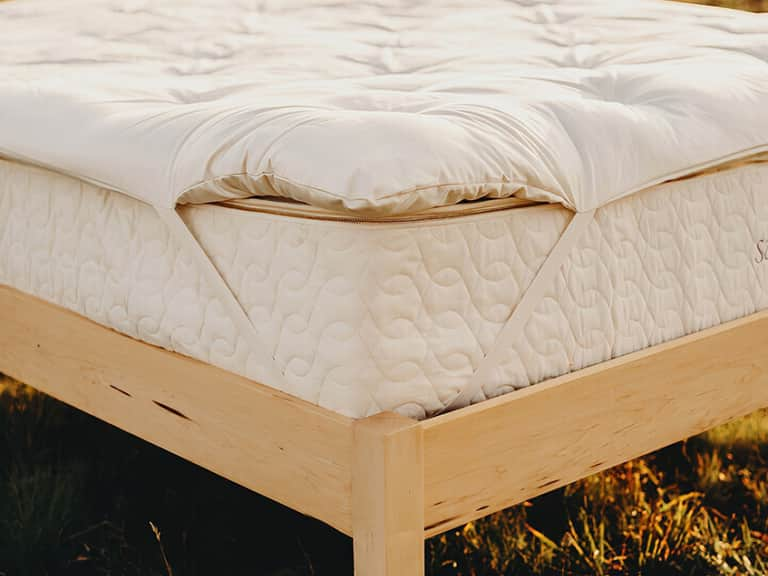
Before comparing certification logos, look for a component-by-component description. A mattress is not one material. It is an assembly: a sleep surface and cover, comfort layers, a support system, internal barriers or pads, and sometimes adhesives, quilting materials, or other elements. Two models carrying a similar certification may still have different constructions and feel quite different in use.
Start by identifying the principal layers. Is the support core made from latex, foam, or springs? What sits above that core? Is there a wool or cotton layer, a foam comfort layer, or more than one material? What fabric forms the cover? Does the documentation name the materials in the fire barrier or other internal components? The answers help turn a broad product description into a more intelligible account of the bed.
Pay attention to how specifically the materials are named. “Latex” identifies a broad material family, while “natural latex” or a named latex process supplies additional detail, if the manufacturer’s documentation explains it. “Foam” alone is similarly general. A useful description may state the foam type and clarify whether it is used in the comfort layer, the support layer, or both. If a material is not identified, do not assume that a nearby certification applies to it.
Layer order matters, too. A cotton cover does not make every interior component cotton, and an organic fiber used in one layer does not establish that the entire mattress is organic. Make a small inventory as you read: cover, comfort layers, support core, fire barrier, and any other specified components. If the product page does not provide enough detail to complete that inventory, consult the product’s technical sheet or ask the company what the missing component is.
Materials and certifications answer different questions
A material description tells you what a component is said to contain. A certification indicates that a particular product, material, facility, or process has been assessed against a defined standard. Those statements can support one another, but they are not substitutes.
For example, a product page might identify organic cotton in its cover and separately display a certification associated with organic textiles. The sensible next question is not simply, “Is this certified?” It is, “Which textile is covered, and is the certificate for this exact product or only for a material, supplier, or process?” The distinction can be consequential. A certificate that applies to a fabric does not automatically establish the composition or certification status of foam, springs, adhesives, or every other part of the finished mattress.
Likewise, a certification concerned with emissions or chemical testing does not, by itself, tell you whether a fiber was grown organically. A standard may focus on chemical residues, emissions, responsible sourcing, or the chain of custody for a particular material. Each scope is distinct. A mattress may have several verified attributes, while other attributes remain outside those particular standards.
Look for the certification’s full name, the organization that administers it, and the product or component it applies to. A logo without context may be difficult to interpret. A manufacturer that names the standard, provides a certificate number or supporting documentation, and explains the covered materials makes the claim easier to check. When information is not available, treat the claim as incomplete rather than filling in the gap by inference.
How to assess organic claims
“Organic” is especially likely to appear in broad, soothing language, though it is most meaningful when attached to a clearly identified material and a verifiable standard. Ask whether the claim refers to the cotton, wool, latex, or another specific input; whether it covers the finished product or only a component; and whether the standard’s scope matches the wording on the product page.
For textiles, certifications such as the Global Organic Textile Standard (GOTS) can be relevant to organic fiber and processing claims. For latex, the Global Organic Latex Standard (GOLS) is a distinct standard. Their names are not interchangeable, and neither should be assumed to cover every part of a mattress simply because one appears in the product description. Check the standard holder’s public information and the product documentation for the specific scope.
Some manufacturers also describe a material as “organic” without displaying a third-party certification for the finished product. That may reflect a claim about an input, but it is not the same as a documented certification covering the whole mattress. Read the exact wording closely: “made with organic cotton” is narrower than “certified organic mattress.” A precise claim can still be useful; it simply should not be enlarged beyond what it says.
When a product page uses several environmental or health-related terms together, separate them. “Organic” concerns a material or production standard. “Natural” is broad and can have different meanings in different contexts. “Low emissions” concerns a different kind of attribute. One does not prove the others. A certification matrix, technical sheet, or written explanation from the manufacturer is often more informative than a cluster of badges.
What other certification language may tell you
Mattress certification programs vary in purpose. Some address chemical content or emissions; others concern the sourcing and processing of particular fibers. Some assess a finished product, while others apply to a component or manufacturing process. Before treating a seal as decisive, find out what the standard actually evaluates.
OEKO-TEX labels, for instance, are associated with testing for specified substances in textile products. The exact program and product class matter, and the label should be checked against the organization’s current description. It does not mean that every mattress component is organic, nor does it necessarily certify a mattress’s complete construction. The relevant question is whether the stated program applies to the cover, a fabric, or some other named item.
CertiPUR-US is a program associated with certain flexible polyurethane foams. If it appears in a mattress description, determine whether it refers to the foam used in that model and what the program’s stated criteria cover. It is not a certification of a cotton cover, a latex layer, or the whole mattress in every respect. The same rule applies to any seal: read its scope, then compare that scope with the claim being made.
Standards and program requirements can change. For current details, consult the organizations that administer the relevant certifications rather than relying solely on a retailer’s summary. A product page is a useful starting point, not necessarily the final record. If the certificate has an issue date, expiration date, product name, or supplier reference, compare those details with the model under consideration.
A practical label-reading checklist
When reviewing a Naturepedic mattress listing or specification sheet, move through the information in a consistent order. This makes comparisons less vulnerable to the persuasive effect of a familiar word or a prominent logo.
- List each layer. Record the cover, comfort materials, support core, fire barrier, and any other identified components.
- Note the exact material names. Distinguish cotton from organic cotton, latex from a specified type of latex, and foam from a named foam formulation.
- Attach each claim to a component. Write down whether a claim refers to the cover, a layer, a material supplier, or the complete mattress.
- Identify the certification program. Find its full name and the organization responsible for the standard.
- Check the scope. Confirm whether the certification covers the finished product, an individual material, a textile, a foam component, or a manufacturing process.
- Look for supporting documentation. Seek a technical sheet, certificate details, or a clear explanation of the certified components.
- Read care instructions. They can reveal whether the cover is removable, how the mattress should be cleaned, and what maintenance the construction requires.
- Record the date. Product specifications and certification status can change; note when you reviewed the information.
A compact comparison table can help keep the exercise factual. Use columns for model, named materials, layer location, certification, certification scope, documentation, and care notes. If a cell cannot be completed from the available information, mark it “not stated” rather than assuming the answer. That small discipline keeps an absence of information from becoming an unsupported conclusion.
Read the fine print on care and construction
Care instructions are not a minor appendix. They describe the practical relationship between a mattress and its owner. A model with a removable, washable cover presents different maintenance options from one whose cover should not be removed or washed. A mattress that requires a particular foundation, periodic rotation, or protection from moisture may ask for a different routine than a bed with fewer restrictions.
Do not assume that a natural or certified material is automatically easy to clean, hypoallergenic for every sleeper, or more durable in every setting. Those outcomes depend on construction, exposure, use, and individual sensitivities. A material can have desirable properties and still require careful maintenance. Follow the manufacturer’s written instructions, especially where warranty terms or the integrity of an internal layer may be affected.
Construction also influences how a mattress feels. A latex comfort layer may respond differently from a foam layer; a spring core differs from an all-foam support system. Thickness, density, firmness, quilting, and the arrangement of layers all contribute. Certification does not predict whether a mattress will suit a particular body, sleeping position, temperature preference, or tolerance for motion. It verifies only the attributes included in the relevant standard.
For this reason, compare material documentation and comfort information side by side. A label can help answer what is in the bed and how a claim is supported. It cannot replace trying a mattress where possible, reviewing the return policy, or assessing the model’s dimensions and support characteristics. The strongest decision is made from several kinds of evidence, none asked to do more than it can.
Questions worth asking the manufacturer
If the product page leaves a gap, a focused question is more useful than a general request for reassurance. Ask which components are covered by each certification and whether the certificate applies to the current model. Ask for the full material composition of the comfort layers, support core, cover, and fire barrier. If a claim refers to a supplier or a material rather than the finished product, ask for that distinction to be stated plainly.
You can also ask whether the specifications vary by size or model, whether a listed certification is current, and where supporting documents can be reviewed. When evaluating organic materials, ask which fibers are certified and by which standard. For emissions or chemical testing claims, ask what product or component was tested and what program or protocol is named. These questions are specific enough to receive useful answers and neutral enough not to presume a problem.
Keep the response with the product information you reviewed. If an answer is verbal, request a written version or a link to the relevant documentation. This creates a simple record, particularly helpful when product pages are revised. A company’s willingness to explain the scope of a claim is itself useful information about how transparent its product communication is, though it does not replace the underlying documentation.
Common mistakes to avoid
- Assuming one seal covers the whole mattress. A certification may apply only to a particular textile, foam, or material. Verify the scope rather than extending it to components not named.
- Treating “natural” and “organic” as synonyms. These words describe different things and may be used with different levels of specificity. Look for the material, the standard, and the documentation.
- Confusing a material claim with a product certification. A mattress that contains a certified component is not necessarily certified in its entirety.
- Taking a health-related phrase as a universal guarantee. A certification has defined criteria and does not establish that a product will be suitable for every person or resolve every sensitivity.
- Ignoring what is not disclosed. Missing details are not proof of a defect, but they are a reason to seek clarification before making a comparison.
- Letting certifications replace comfort and care considerations. A well-documented mattress may still be the wrong firmness, height, or maintenance fit for a particular household.
A clearer way to compare Naturepedic mattresses
When comparing Naturepedic models, keep the question narrow at first: what does each model say it is made of? Then ask how those materials are arranged. Only after that should you attach certification information to the appropriate components. This order makes it less likely that a prominent certification will eclipse a meaningful difference in construction—or that a material description will be mistaken for independent verification.
For each model, note the exact names of the cover fabric, comfort materials, support system, and fire barrier. Add any stated thickness or firmness information, then record the certifications and their scopes separately. Include the available care instructions and any product-specific documents. A comparison made this way can reveal where two mattresses share materials, where they differ, and where the information is too limited to support a confident conclusion.
Give greater weight to claims that are specific, traceable, and consistent across the product page and supporting documentation. “This named component is covered by this named standard” is more informative than an unqualified list of seals. A precise limitation is also valuable: a manufacturer that identifies which parts are covered helps the reader understand the boundaries of the claim.
The useful conclusion
Reading mattress materials and certifications is less about decoding a secret language than keeping separate facts in their proper places. Materials describe composition. Certifications describe verification against particular criteria. Construction explains how components work together. Care instructions describe the obligations of ownership. Comfort remains a personal assessment, not a conclusion printed by a standards organization.
For Naturepedic mattresses, as for any product, check what each layer contains, which certification applies to which component, and whether the documentation supports the wording on the label. When a claim is broad, seek a narrower explanation. When a detail is missing, mark it as unknown. This is a modest form of consumer research, but it is also an effective one: it replaces the glow of a badge with a useful account of what the mattress is—and what the available evidence can actually tell you.